
The cover of a book is the beginning of a conversation between the author and the reader. – David Pearson
Creating a book cover was something I never imagined would be so challenging. As a part-time writer, I’ve always been more of a word person than a visual one. While I understand the importance of a compelling cover, I didn’t have the financial means to hire a designer. So, I decided to experiment on my own.
I chose covers that resonated with me, using Canva to create my designs. Unfortunately, none of them gained approval when tested with my audience.
Although I clearly knew how I wanted the cover to look, I struggled to execute that vision. Let’s examine some of these covers and why they didn’t work.
1 Image Covers
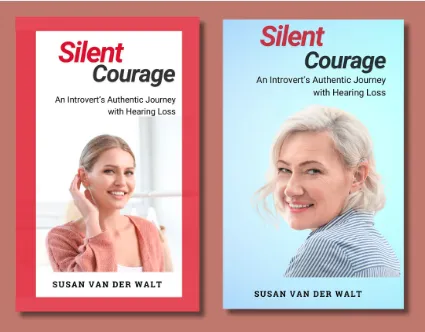
The red cover was my first attempt. I liked the basic idea but found the red border too harsh. I appreciated the subtle hint of hearing loss, with the woman touching her ear, but I didn’t think this image would resonate with my target audience, which tends to be in a more mature age group.
For the second cover, I chose a calmer blue colour and a woman closer to my audience’s age. However, despite the better fit, this image didn’t effectively convey the concept of hearing loss.
This was my main challenge: I’m not an artist, and I had to rely on images available on Canva, Unsplash, and similar platforms. Many of the images I found were too generic and didn’t fully capture the essence of what I wanted to convey.
2 Covers Using Elements

For my next attempt, I decided to try something different. After researching colour psychology, I settled on dark blue, thinking it would reflect the themes of my book. I added elements like music notes and sound waves to represent sound but received mixed feedback. The feedback showed me that these designs didn’t convey the book’s message as I had hoped.
Once again, the available elements on these platforms limited my ability to achieve the look I envisioned.
3 Experimenting With AI

At this point, I decided to experiment with AI. I prompted ChatGPT to suggest symbols for hearing loss and introversion, and I tried to incorporate those into my designs. Hearing loss symbols are often ears, hearing aids, or sound waves.
For introversion, I liked the idea of using a feather. To me, the feather represented softness, resilience, and introspection. The muted colours of the first cover gave it a thoughtful, meditative feel, and I decided also to try the darker blue that had worked in previous designs.
Despite their beautiful design, these covers didn’t work because my test group didn’t understand the feather’s symbolism.
By this point, I was feeling completely at my wit’s end. I’d run out of ideas, and nothing seemed to click. Strangely enough, I found it much harder to distance myself and be objective about these designs than with my writing.
I thought I’d either fall in love with it or it would grow on me over time. But even with that niggling doubt in my mind, it was still hard to let these designs go as less-than-ideal solutions.
Fortunately, my artistic sister came to my rescue. Together, we finally created the perfect cover for my book.
It took a lot of trial and error, but the result truly represents the heart of Silent Courage. I can’t wait to share it with you.
Stay tuned for the cover reveal next week!
Quiet Words that Linger.
If this reflection resonated, you’re warmly invited to explore my Silent Courage course collection, offering practical and reflective support for introverts and people with hearing loss navigating life, communication, and connection at their own pace. Browse the available courses here.

Leave a Reply